
Beyond the Buffer Zone: Israel’s Growing Occupation Inside Syria
Events in Lebanon, the West Bank and Gaza have overshadowed what is a crucial set of developments in large parts of Syria since the fall of the Assad regime.

The international conversation has paid remarkably little attention to Israel’s ongoing occupation and repeated incursions into Syria.
Israel’s new Syria plan started shortly after a lightning rebel advance, led by Ahmed al-Sharaa, reached Damascus on December 8th, 2024. Within hours, the IDF had invaded the demilitarized territory separating Syria from the occupied Golan Heights, in violation of a 1974 Disengagement agreement designed to establish a neutral zone separating the two countries.
In addition to its incursions, Israel has repeatedly struck Syria’s Air Force, its navy and heavy weaponry installations with the aim of neutering Syria militarily and reinforcing Israeli dominance over the territories it controls. In the year after the fall of the Bashar al-Assad regime, Israel had conducted at least 600 strikes on Syria, resulting in exactly zero retaliatory strikes by Syria.
To be clear, the new Syrian leaders don’t have much leverage. They are ruling over an economically broken country that has endured years of war, corruption and punishing sanctions.
“The Syrians are betting a lot on the Americans,” Ibrahim Hamidi, editor in chief of Al Majalla magazine tells me. “The new leaders said we have no interest in waging war and we would like to address this new occupied territory by diplomatic means.”
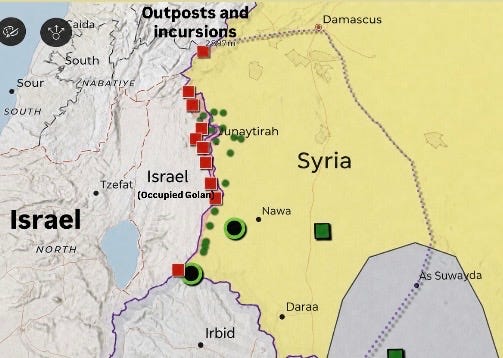
But those pleas have fallen on deaf ears. In the last 18 months, the IDF has set up military outposts and conducted repeated incursions deeper into Syrian territory, raising concerns that its occupation of large swaths of the country is becoming entrenched.
By mid-2025, satellite imagery reported by the Syrian Network for Human Rights “confirmed the presence of at least six military bases” inside the demilitarized zone occupied by the IDF. A recent Human Rights Watch report describes various abuses by Israeli forces against the local population, including forced displacement and home seizures and demolitions.
The Israeli military has also launched airstrikes against the Syrian military that it says are in defense of the Syrian Druze after clashes between Syrian government forces and the Druze population in Suweida. Those events marked a dark chapter in the new Syria with reports of civilian massacres but that Israel is accused of exploiting to further solidify its foothold into Syrian territory.
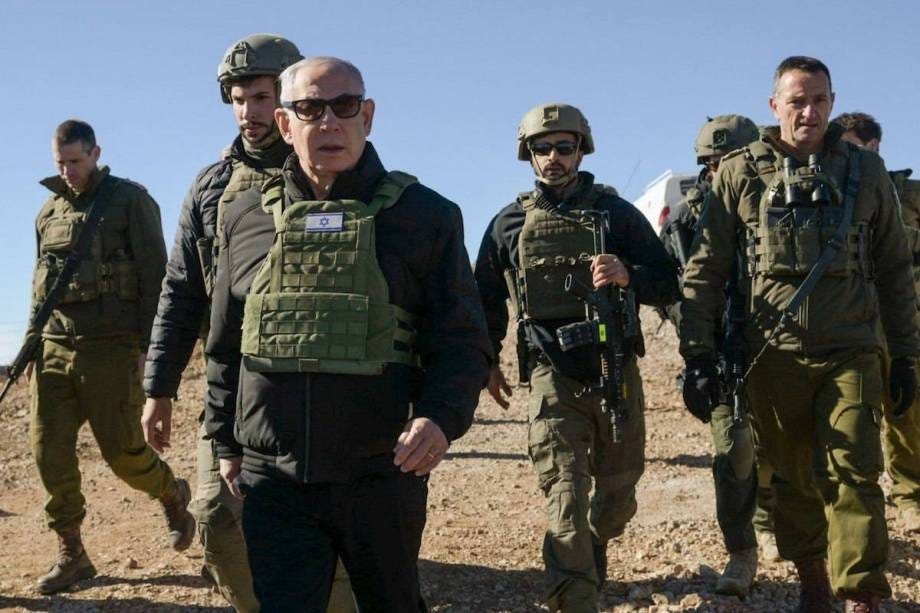
The Israeli Prime Minister’s statements and actions have further clarified his government’s intentions. In what Syria’s ambassador to the United Nations called a “provocative tour,” Benjamin Netanyahu visited parts of Syria occupied by his forces in November 2025, claiming the occupation there was “to ensure the security of Israeli citizens.”
He also demanded that Syria establish a “demilitarized buffer zone from Damascus to the buffer zone, including of course the approaches to Mount Hermon and the Hermon peak” within its own borders.
It’s unsurprising that Israel wants to keep control of the Hermon Peak, the highest point in Syria, once inside the demilitarized zone but now under IDF control. Netanyahu’s demands that Syria abandon all claims to control its own security are met with dismay inside the country but have so far not led to any significant pushback on the international stage.
Many people remember the November 2025 meeting between Syria’s interim president and U.S. President Donald Trump for an awkward Oval Office moment in which Ahmed al-Sharaa was sprayed with “Trump Cologne” by Trump himself. The exchange clearly left an impression on the American president, who later sent additional bottles with a note: “Just in case you ran out!”
The Syrian president later posted a message of thanks on X, writing in part: “Thank you, Mr. President @realDonaldTrump, for your generosity and for topping up this precious gift.”
But cologne was not top of the agenda for the visiting Syrian delegation.
“We know that when Ahmed al-Sharaa met with President Donald Trump November 10th, 2025, he urged Trump to play a role with Netanyahu tell him to pull out from the territories occupied after the fall of the Assad regime. And Trump promised to help,” Ibrahim Hamidi told me.
So far, though, that help has not materialized. Israel’s occupation of the territory it now controls inside Syria has remained in place, despite the signing in January 2026 of an intelligence-sharing agreement between the two countries focused on de-escalation. In all, up to 400 square kilometers of land, which includes several new Israeli outposts and military checkpoints, remain under IDF control.
The worry among many Syrians is that Israel will not only remain, but quietly seek to annex the territories it now occupies. In the same way the part of the Golan Heights seized by Israel in 1967 was later unilaterally annexed in 1981.
Those fears may not be unfounded: in April, The Israeli government approved a $334 million, multi-year plan to expand settlements in the occupied Syrian Golan Heights. The project seeks to bring about 3,000 additional Israeli settler families to the area by 2030.
I’m even more concerned about what happens after that - who will stop even further advancement into Syria?
This is all so worrisome. And I also wonder how far Israel will go and what will stop them from occupying Damascus.
Sharing this on my social media. This is by far the most comprehensive piece I've read about the on-going Israeli occupation in Syria.
So many people know nothing about this.